
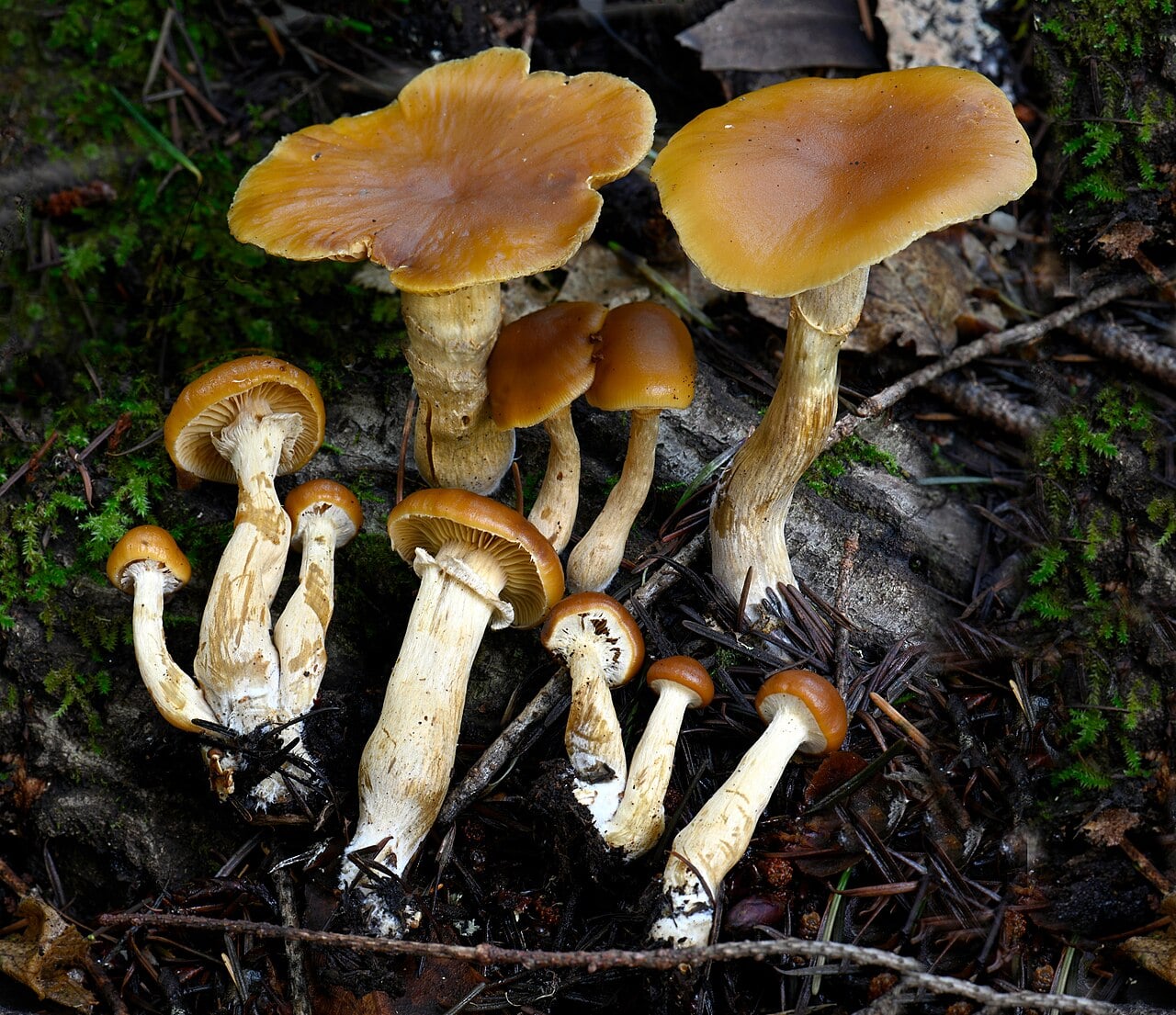
A mushroom smaller than a fingernail has delivered a startling first for fungal biology: Galerina indica produces both psilocybin, the compound associated with psychedelic mushrooms, and amatoxins, the lethal chemicals found in death caps and other notorious fungi. The newly identified chemical combination has earned the Florida species the nickname “dark magic mushroom.”
Researchers from the University of Florida and collaborators found the tiny brown fungus growing from moss-covered palm trunks in forested wetlands. The team collected five Galerina specimens across the southeastern United States, but the three Florida specimens identified as G. indica were the ones carrying both chemical systems. The largest mushrooms measured only about 0.5 centimeters tall, with caps roughly 0.25 centimeters wide.
Mass-spectrometry testing detected psilocybin and psilocin alongside two amatoxin compounds. One of those chemicals appears to be previously unknown in mushrooms: the researchers have named it alpha-proamanitin. It resembles alpha-amanitin, the best-known amatoxin, but lacks one hydroxyl group in its structure. That difference may make it less potent than alpha-amanitin, although it remains a serious toxicological concern.
Amatoxins are especially dangerous because they interfere with RNA polymerase II, an enzyme cells need to make proteins. Severe exposure can lead to delayed liver and kidney failure, which makes the mushroom’s appearance particularly deceptive: neither its small size nor any psychedelic effect would make it safe to handle or consume. The researchers also caution that blue bruising, sometimes associated with psilocybin mushrooms, cannot reliably distinguish a psychedelic species from a poisonous one in unfamiliar fungi.
The genetic explanation may be as unusual as the chemistry. The study identified the five canonical Psi genes involved in psilocybin production, while the amatoxin pathway appeared in a separate gene cluster resembling the system found in toxic Galerina species. Their arrangement and evolutionary history suggest that G. indica acquired psilocybin-making genes through horizontal gene transfer after its lineage already possessed the amatoxin pathway. The researchers estimate that the psilocybin capability entered this lineage roughly 15.5 million years ago.
Horizontal gene transfer allows organisms to acquire genetic material from unrelated organisms instead of inheriting it directly from parents. It is well documented in fungi and has helped distribute both psilocybin and amatoxin pathways across distantly related mushroom groups. The new finding suggests that these mobile biochemical toolkits can occasionally converge in one species, potentially changing how the fungus deters animals from eating it.
Andrew Kunik discovered the unusual specimen while documenting fungi at the University of Florida’s Ordway-Swisher Biological Station in work led by plant pathologist Matthew E. Smith. Their collaborators included researchers in chemistry, pathology, fungal biology and evolutionary genetics from the University of Florida, the University of Utah and Ohio State University. For mushroom hunters, the practical takeaway is simple: Galerina contains many dangerous species, and an unfamiliar little brown mushroom should never be treated as a recreational psychedelic.
Image Credits
In-Article Image Credits
Galerina marginata mushrooms from Point Reyes National Seashore, California via Wikimedia Commons by Alan Rockefeller with usage type - Commercial license. By Alan Rockefeller - Own work, CC BY-SA 4.0, https://commons.wikimedia.org/w/index.php?curid=95423433Featured Image Credit
Galerina marginata mushrooms from Point Reyes National Seashore, California via Wikimedia Commons by Alan Rockefeller with usage type - Commercial license. By Alan Rockefeller - Own work, CC BY-SA 4.0, https://commons.wikimedia.org/w/index.php?curid=95423433


