
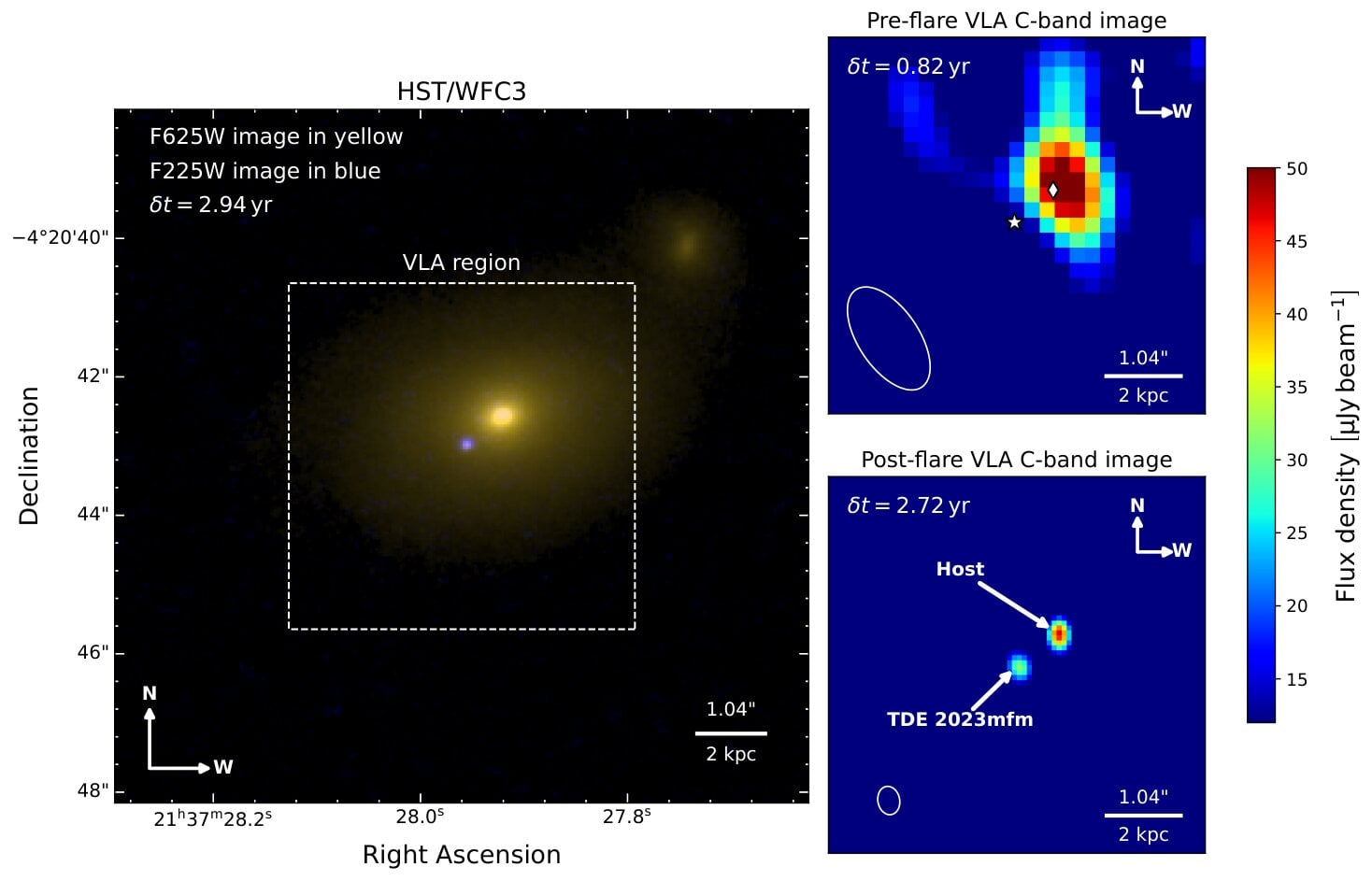
A star’s violent destruction has exposed an unexpected double-black-hole system: one black hole sits in the heart of its galaxy, while another appears to be roaming more than 1,000 parsecs away. The event, designated TDE 2023mfm, is the latest example of how stellar catastrophes can illuminate otherwise invisible massive black holes. Phys.org first reported the discovery, based on research led by Itai Sfaradi and posted to the arXiv preprint server.
TDE 2023mfm began as an optical transient spotted by the Zwicky Transient Facility on June 28, 2023. In a tidal disruption event, a star passes close enough to a massive black hole for extreme gravity to stretch and tear it apart; some of the stellar debris then falls inward, producing a flare visible across multiple wavelengths. The researchers classified this event as a hydrogen-rich TDE-H after detecting a broad hydrogen-alpha feature moving at roughly 18,000 kilometers per second.
The follow-up campaign was unusually broad. Optical and ultraviolet data came from ZTF, Hubble and Swift, while Keck and Lick supplied spectroscopy. Chandra and XMM-Newton examined the system in X-rays, and the Karl G. Jansky Very Large Array tracked its radio behavior. Hubble ultimately measured the transient’s separation from the host-galaxy center at 0.66 arcseconds, corresponding to 1.08 kiloparsecs at the galaxy’s distance. Independent VLA work likewise resolved a radio source at roughly the same off-nuclear position, strengthening the case that the flare did not originate from the central nucleus.
The wandering object is estimated to contain between roughly one million and ten million solar masses, with the paper adopting a mass near 106.2 solar masses. That is far smaller than the black hole inferred at the galaxy’s center, whose estimated mass is on the order of 108 solar masses. The host itself is a massive galaxy of approximately 1011 solar masses and shows signs of a low-luminosity active galactic nucleus, implying that astronomers are seeing evidence for at least two massive black holes in the same galactic neighborhood.
How the off-center black hole got there remains unsettled. The authors favor a scenario in which it arrived during a minor merger, perhaps as the remnant nucleus of a smaller galaxy that was largely stripped away. Hubble data indicate an unresolved stellar component at the disruption site that could be a surviving dwarf galaxy core or nuclear star cluster. Other possibilities include an inspiraling black-hole pair or gravitational-wave recoil, although the presence of an active central black hole complicates explanations that require the wandering object to have been the galaxy’s sole nuclear remnant.
The discovery also demonstrates why transient surveys matter beyond cataloging spectacular flashes. The original optical flare identified the event, but high-resolution imaging and years of radio monitoring separated the off-nuclear source from the galaxy’s active center. The researchers say future Hubble and James Webb Space Telescope observations could identify the stellar remnant’s nature, while very-long-baseline interferometry and continued radio work may reveal whether the late radio emission came from a delayed outflow or a jet viewed from an unusual angle. For now, TDE 2023mfm offers a rare observational glimpse of a massive black hole traveling through a galaxy rather than sitting quietly at its center.


