
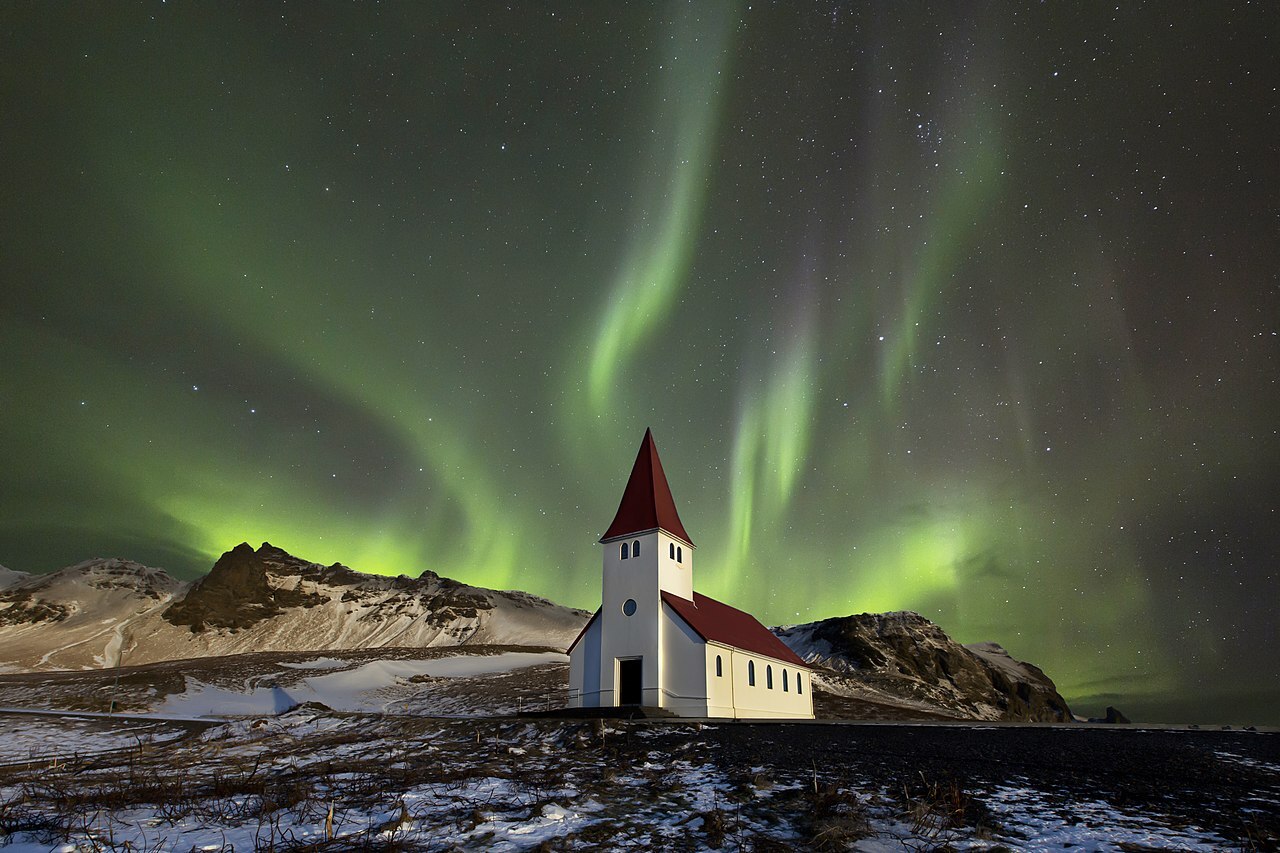
Those shimmering green and red curtains are not merely a beautiful nighttime spectacle. An aurora is the visible edge of a much larger space-weather event—one that can also interfere with satellites, navigation, communications, and the electrical infrastructure beneath our feet. The same solar activity that creates auroras can threaten power grids when it disturbs Earth’s magnetic environment.
The chain reaction begins with the Sun’s constant stream of electrically charged particles, known as the solar wind. Stronger outbursts, including coronal mass ejections, can send especially dense clouds of plasma and magnetic energy toward Earth. When that material encounters the planet’s magnetosphere, magnetic reconnection transfers energy into the protective bubble surrounding Earth and funnels energized particles toward the polar atmosphere. NASA explains that process as the engine behind auroral displays.
High above the surface, those particles collide with oxygen and nitrogen. The gases absorb energy and then release it as light, producing the colors people associate with the northern and southern lights. Oxygen can generate the familiar green glow, while higher-altitude oxygen emissions can appear red; the exact colors and shapes depend on particle energy, atmospheric composition, and altitude. A powerful geomagnetic storm can push the auroral oval much farther from the poles, making the display visible across regions that rarely see it.
On the ground, the danger comes from a different part of the same disturbance. A changing magnetic field induces electric fields across Earth’s surface, and those fields can drive geomagnetically induced currents through long conductors. Power-transmission lines and grounded transformer networks can become unintended pathways. NOAA warns that severe storms can damage high-voltage transformers, components that may take days, weeks, or longer to replace. The U.S. Geological Survey likewise says storm-driven currents can disrupt grid operations and potentially damage transformers.
That does not mean every bright aurora is a prelude to a blackout. Grid operators monitor solar eruptions, geomagnetic forecasts, and measurements from ground-based magnetometers so they can adjust system operations when conditions worsen. The wider impact can also reach GPS and other GNSS services, satellite electronics, radio communications, pipelines, and spacecraft. NOAA identifies both auroras and harmful grid currents as consequences of geomagnetic storms.
For skywatchers, the result may be an unforgettable light show. For infrastructure planners, it is a reminder that Earth’s electrical systems remain connected to events originating millions of miles away. As monitoring improves and solar activity rises and falls through the Sun’s roughly 11-year cycle, the practical challenge is not stopping auroras—it is ensuring that the systems supporting modern life can withstand the space weather that powers them.


