
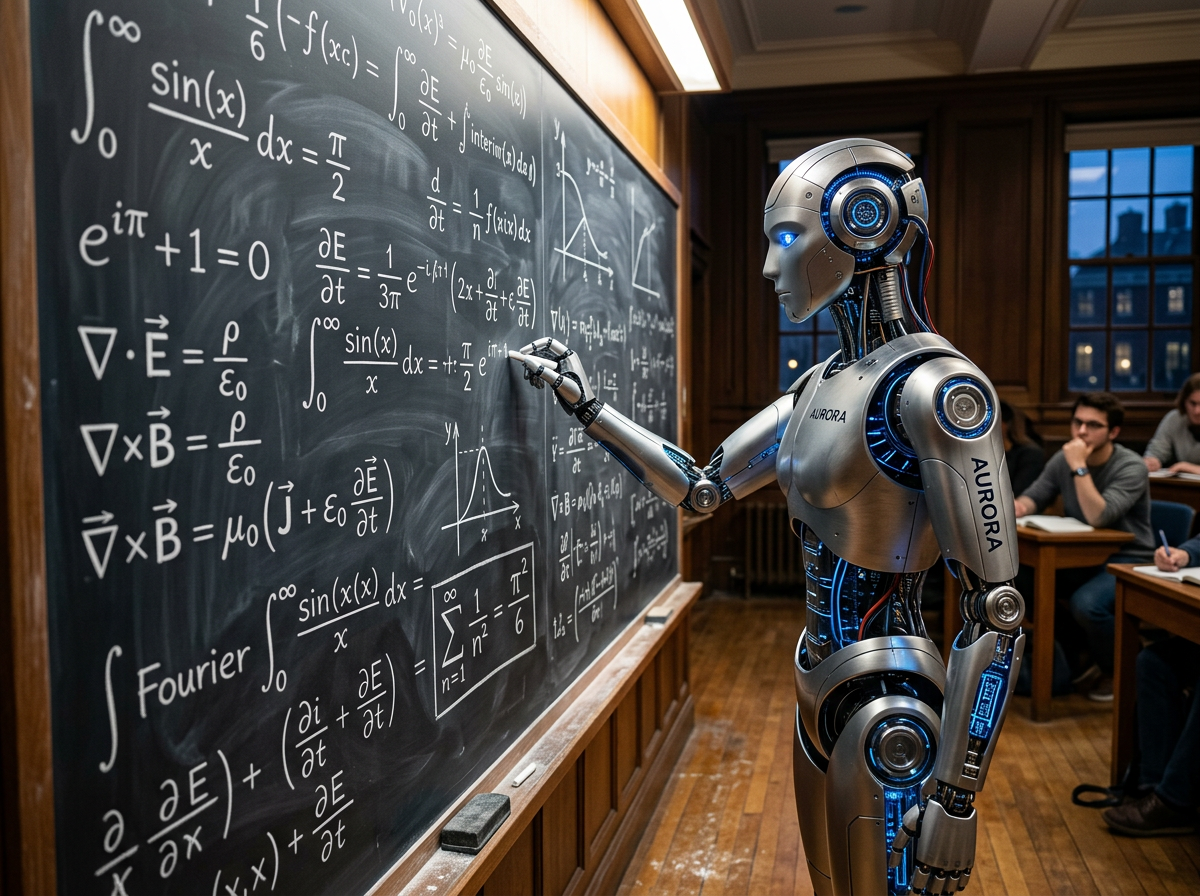
Mathematics has always been a tool for extending human reach. Now, as artificial intelligence tackles problems too large or intricate for people to follow, it may be turning into something stranger: a source of answers whose underlying logic we can no longer fully see. That tension drives the new book Big Math, from Cornell mathematicians Steven Strogatz and Alex Townsend.
Big Math: The Hidden Codes That Run Our World went on sale November 10, 2026, through Little, Brown and Company. The authors frame “big math” as the largely invisible machinery behind search engines, streaming recommendations, GPS routing, weather forecasts, medical imaging, social networks, and artificial intelligence. Its building blocks are not necessarily exotic: matrices, vectors, networks, optimization, Markov chains, and linear algebra do much of the heavy lifting.
The book’s central concern is what changes when those tools operate at a scale beyond unaided human comprehension. Computers already let researchers manipulate quantities and datasets that would overwhelm an individual mind. Modern AI pushes that separation further, producing useful results without offering explanations that humans can reliably inspect. A review in Nature describes the book as both a history of mathematics’ technological reach and an examination of systems that can generate answers too complicated to explain.
Strogatz brings an unusually broad popular-mathematics background to the project. His research has covered chaos, biological synchronization, supercoiled DNA, and network dynamics, including the influential work on “small-world” networks he co-authored with Duncan Watts. He also helped explain the mathematics behind the wobble of London’s Millennium Bridge and has written Sync, The Joy of X, and Infinite Powers, among other books.
Townsend adds an applied-mathematics perspective shaped by computational methods and large-scale scientific problems. Together, the authors are less interested in presenting technology as magic than in showing how familiar mathematical ideas became the infrastructure of everyday life. A Cornell overview points to the book’s focus on the algorithms governing everything from online communication to medical and scientific breakthroughs.
That makes Big Math relevant beyond classrooms and research labs. If AI systems increasingly discover patterns, optimize decisions, or propose solutions that people cannot easily reconstruct, understanding their mathematical foundations becomes part of understanding their limits. The authors’ argument is not that humans should abandon these systems, but that we need enough mathematical literacy—and enough institutional responsibility—to decide when an opaque answer deserves trust.
Strogatz and Townsend will discuss those questions at Cornell on November 17 in an event focused on the mathematical ideas behind AI, quantum computing, and the technologies reshaping modern life. For readers accustomed to treating algorithms as invisible background code, Big Math offers a more unsettling possibility: the future may belong to mathematics that humans design, deploy, and depend on without ever completely understanding.


