
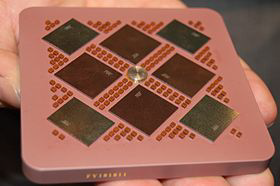
Huawei is aiming far beyond today’s giant AI server farms with Peerium, a computing architecture designed to let as many as one million processors operate as a single computer. The company unveiled the system on September 17 at its annual CONNECT event, positioning it as infrastructure for the next generation of enormous AI training and inference workloads. Huawei’s million-chip computing plan arrives as AI developers increasingly run into the limits of conventional cluster designs.
The central challenge is coordination. In a typical AI cluster, accelerators are distributed across servers and racks, with networks shuttling model data between them. As the number of chips rises, communication delays and bandwidth bottlenecks can undermine the benefit of adding more hardware. Huawei says Peerium addresses that problem through nested parallelism, unified memory addressing, and direct peer-to-peer connections rather than treating each server as an isolated island. The company describes the approach as a way to make hundreds of thousands of processors behave more like parts of one machine. Huawei’s announcement also identifies Nested Bulk Synchronous Parallel as a foundational element of the architecture.
UnifiedBus is the networking layer intended to make that scale practical. Huawei says the high-speed interconnect uses a single protocol to connect CPUs, NPUs, memory, solid-state storage, network cards, and switches, extending peer communication across computing, storage, and networking hardware. Company officials have claimed inter-rack bandwidth of up to 800GB per second, compared with the substantially lower bandwidth Huawei associates with conventional arrangements that use separate technologies for connections inside and between racks.
The first products built around Peerium are the Atlas 950 SuperPoD and larger SuperCluster systems. Huawei says an Atlas 950 SuperPoD can include more than 8,000 Ascend 950DT AI accelerators, while a SuperCluster combines multiple such systems. The company has also said that a 256,000-card SuperCluster is already being deployed and tested, with an Atlas 960 system using near-packaged optics under development.
Huawei’s ambitions reflect the escalating size of frontier AI models in China. HiSilicon chief scientist Liao Heng has said Chinese AI laboratories could soon pursue foundation models ranging from 10 trillion to 40 trillion parameters, creating demand for computing infrastructure well beyond the scale of today’s best-known systems. Huawei says Peerium-based machines could support models with as many as 40 trillion parameters, though that figure remains a company target rather than an independently demonstrated training result.
The architecture also represents a strategic bet for Huawei as restrictions on advanced semiconductor access continue to push China toward domestic alternatives. Rather than competing only on an individual accelerator’s performance, Huawei is presenting the full stack—Ascend processors, interconnects, memory access, and cluster software—as the product. Independent testing at the one-million-processor scale has not yet established how Peerium compares with rival systems in real-world workloads, but the 256,000-card deployment could provide an important early test. If Huawei can turn that design into a reliable production platform, the contest over AI hardware may increasingly be decided by how effectively entire supercomputers work together, not simply by how fast one chip can run.


