
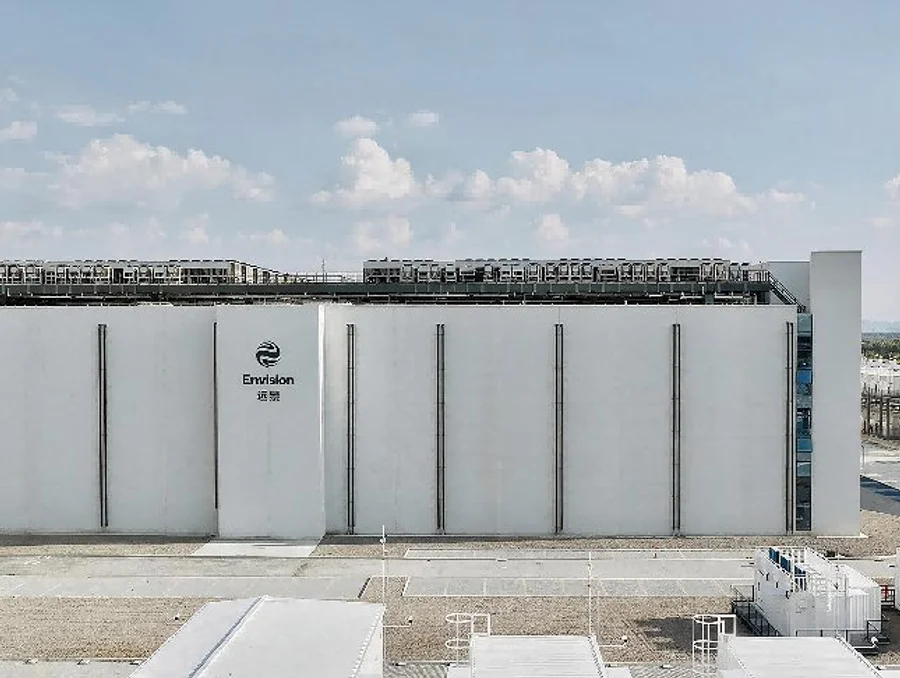
Envision Energy has put a new 800-volt direct-current power architecture into live service at its Galaxy AI data center campus in Ulanqab, Inner Mongolia. The company describes the installation as the first commercial deployment of an integrated 800V DC system for a large-scale AI facility, a milestone that could help data centers feed more electricity to increasingly demanding accelerator racks. The new power system is already supporting live computing workloads.
Rather than sending electricity through several conventional conversion stages, Envision’s design uses solid-state transformers to convert 10-kilovolt medium-voltage AC directly into an 800V DC bus. Battery energy storage sits alongside the system, providing rapid support for short power disturbances and backup measured in minutes. The company says its Dubhe Controller, assisted by the Dubhe Energy Foundation Model, coordinates the transformers and batteries in real time.
That coordination is aimed at one of the more difficult problems created by modern AI workloads: GPU clusters can change their power demand sharply as training and inference jobs shift. Envision says the system can respond at millisecond timescales, absorbing those fluctuations locally instead of forcing the wider electrical infrastructure to handle every sudden change. The architecture also reduces conversion equipment, cabling, copper use, and the physical footprint required for power delivery, according to the company’s announcement.
The implications are less about a new consumer product than about how quickly AI infrastructure can scale inside constrained facilities. Higher-voltage DC distribution can help operators deliver more power to denser racks while reducing some of the losses and hardware associated with repeated AC-to-DC conversions. It also gives storage and renewable generation a more direct role in the data center’s power chain, although real-world efficiency, reliability, and maintenance results will need to be demonstrated over longer operating periods.
Envision’s Galaxy campus began operations in August 2026 and is planned to reach 3 gigawatts, with a stated eventual capacity of as many as one million AI accelerators. More than 80 percent of the site’s power is planned to come from direct renewable-electricity connections, making the campus a test case for combining large-scale compute with locally sourced wind and solar power.
The company intends to use the Ulanqab deployment as a foundation for Mission Gobi, a broader plan to establish 5GW of green AI data center capacity in desert and arid regions worldwide by 2030. Those locations offer room for renewable generation and large campuses, but they also bring challenges involving transmission, cooling, water, and storage. If Envision’s 800V system performs as promised, its significance may ultimately be measured not by a single data center, but by whether it makes power-dense AI campuses easier to build in places where energy and land are available together.
Image Credits
In-Article Image Credits
Envision’s Galaxy AIDC Campus in Ulanqab, Inner Mongolia, China. via Wikimedia Commons by Envision with usage type - Product photo (Fair Use)Featured Image Credit
Envision’s Galaxy AIDC Campus in Ulanqab, Inner Mongolia, China. via Wikimedia Commons by Envision with usage type - Product photo (Fair Use)


