
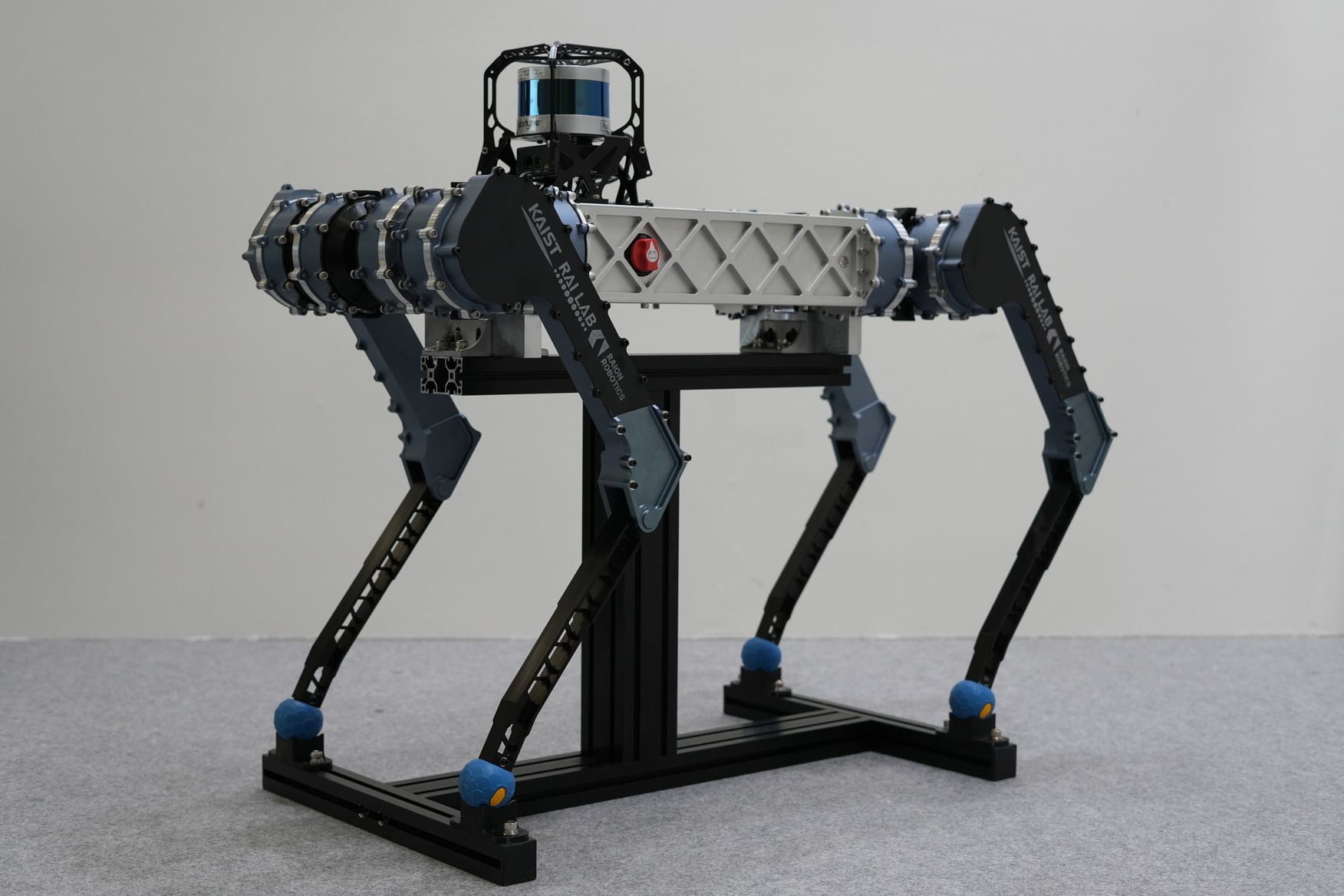
South Korea’s quadruped robot RAIBO2 has officially joined the marathon club, completing a full 42.195-kilometer race on a single battery charge and finishing faster than the average human runner. The run took place during the 2024 Sangju Dried-Persimmon Marathon, where the dog-like machine clocked 4 hours, 19 minutes and 52 seconds without any recharge or battery swap. A detailed study titled “A quadruped robot designed to complete a marathon on a single battery charge,” published in Nature, unpacks how a team from the Korea Advanced Institute of Science and Technology (KAIST) engineered this endurance breakthrough.
Legged robots have historically been sprinters, not distance runners: most state-of-the-art quadrupeds struggle to operate much beyond roughly 20 kilometers before needing a new battery or a charge. RAIBO2’s marathon effort more than tripled that practical range benchmark, and the team reports that under ideal conditions the robot can now travel up to around 67 kilometers (about 41.6 miles) on a straight path using a single pack. Before tackling public roads, RAIBO2 had already completed a 43-kilometer GPS-guided loop on a flat athletic field, while an earlier attempt on uneven terrain had to be abandoned around 37 kilometers when its battery finally gave out.
To turn a lab prototype into a robot that could survive a real marathon, the engineers systematically attacked RAIBO2’s energy budget. They boosted its battery capacity by roughly 33 percent and overhauled the control system to adjust joint stiffness on the fly, allowing the legs to soften to absorb impacts and then stiffen for powerful push-offs without wasting energy. During the successful marathon run, RAIBO2 consumed about 1,280 watt-hours of electricity and used less energy to move each kilogram of its weight over one meter than the average human runner, pointing to a clear efficiency edge. In technical terms, the robot achieved a total cost of transport of 0.25, beating the typical human benchmark of around 0.37 and becoming the first quadruped robot documented to surpass that figure. The Nature paper credits that performance to lightweight hardware, highly efficient motors and actuators, and reinforcement learning-based controllers that fine-tune the robot’s gait for different speeds and surfaces.
RAIBO2’s achievement wasn’t logged on a cushy lab treadmill. The Sangju course includes winding public roads, two major climbs, and a total elevation change reported at roughly 286 meters, with slopes as steep as 10 degrees and sections made treacherous by slippery surfaces. Throughout the race, the robot maintained an average speed of about 2.64 meters per second—around 5.9 miles per hour—while autonomously handling balance and foot placement even as conditions changed. Human operators still played a role, remotely guiding RAIBO2’s pace and issuing high-level commands, but the machine’s gait control and energy management systems did the hard work of keeping it upright and efficient for more than four hours. The final time put the robot slightly ahead of the global average human marathon finishing time, underscoring just how far legged machines have come from clumsy lab demos.
On the robotics industry scoreboard, RAIBO2’s run is more than a flashy stunt—it sets a new endurance benchmark that outpaces comparable American and Chinese quadrupeds by more than a factor of three on a single charge. KAIST and its spin-off company behind RAIBO2 note that this is the first documented case of a walking robot completing a full-course marathon in an official event, and it remains the only example to date. The research team frames the work as a stepping stone toward legged robots that can handle long-distance outdoor missions, from search-and-rescue and infrastructure inspection to remote exploration, without constantly tethering themselves to chargers or battery swaps. KAIST’s group and its commercial spinoff are now working to translate RAIBO2’s technology into deployable platforms that can leave the lab and operate as real-world field robots, not just viral video stars.
For geek-culture fans who grew up on anime mecha, Boston Dynamics clips, and video game robot companions, RAIBO2’s marathon feels like a moment when sci-fi endurance starts to look real. A dog-like machine casually trotting through a public race faster than the average human hints at a future where legged robots run long-range patrols, traverse open-world landscapes, or even compete in their own “robot Olympics.” The next wave of robot athletes won’t just be about speed or parkour tricks—they’ll be about stamina, efficiency and the ability to stay in the game for hours at a time. RAIBO2 just set the pace, and every other robot dog now knows exactly how far it needs to go to catch up.


