
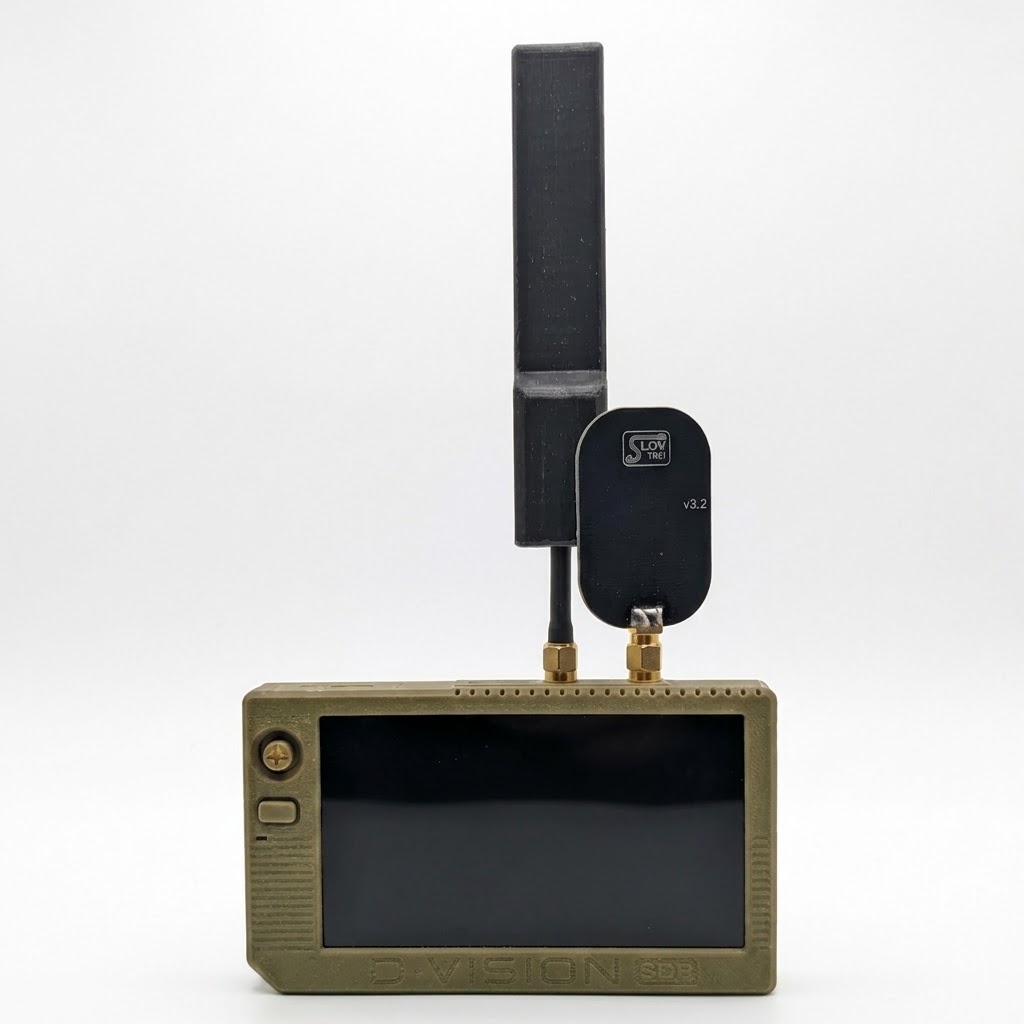
Ukraine’s CODE380 has turned a weakness in Russia’s drone fleet into a battlefield warning system. The Kyiv-based radio manufacturer’s pocket-sized D·Vision SDR can scan a broad slice of the radio spectrum, capture unencrypted analog video from airborne drones, and show troops what an aircraft is seeing in real time. The device and its reported capabilities are detailed in coverage of the Ukrainian receiver.
Unlike a conventional detector built around a handful of fixed channels, D·Vision uses software-defined radio to sweep frequencies from 500 MHz to 8.7 GHz. CODE380 says it can display analog feeds from as far as six miles away on signals between 540 MHz and 6 GHz; at higher frequencies, its stated detection range falls to roughly two or three miles. The approach also gives the company a way to update the receiver’s software as Russian drone designs and radio configurations change. Defense News reported that the receiver converts intercepted signals into video rather than merely alerting users to radio activity.
Portability is a major part of the pitch. D·Vision weighs about 290 grams, or roughly 10 ounces—close to the weight of a large smartphone and substantially lighter than several other Ukrainian-made receivers. The Vydun 7.5 weighs around 900 grams, while the Chuyka 3.0 and SENSE-4 weigh approximately 650 and 600 grams respectively. That difference matters for infantry units that need to carry detection equipment alongside radios, ammunition, batteries, and other electronic-warfare gear.
The receiver arrives as Russian forces exploit a frequency gap in Ukraine’s existing defenses. Communications and electronic-warfare specialist Serhii “Flash” Beskrestnov has warned that Molniya strike and reconnaissance drones began using the 4.1-to-4.5 GHz range for video transmission in June. Many portable detectors were designed around more familiar bands such as 1.2, 2.4, and 5.8 GHz, leaving them poorly equipped to recognize signals clustered around 4.3 to 4.5 GHz. Coverage of Beskrestnov’s warning described the resulting blind spot as a serious frontline problem.
Seeing a drone’s camera feed can give defenders more than an early alert: it may reveal the aircraft’s direction, intended target, and the pilot’s approach before impact. However, D·Vision is not a universal counter-drone solution. Its primary strength remains analog video interception, and Russia could reduce that advantage by moving to encrypted or digital links. CODE380’s documentation reportedly includes compatible digital detection for DJI Mavic drones, but the company would need to study captured Russian hardware to support additional systems. Militarnyi’s technical overview identifies support for PAL and NTSC analog video alongside compatible DJI signals.
The receiver is also powerless against fiber-optic drones, which communicate through a physical cable rather than a radio link and therefore resist both conventional jamming and over-the-air interception. In practice, D·Vision is best understood as one layer in a larger defense network that combines radio monitoring with radar, acoustic detection, electronic warfare, and physical interceptors. Its most important contribution may be speed: turning a drone’s own broadcast into actionable intelligence before the aircraft reaches the people it is targeting.


