
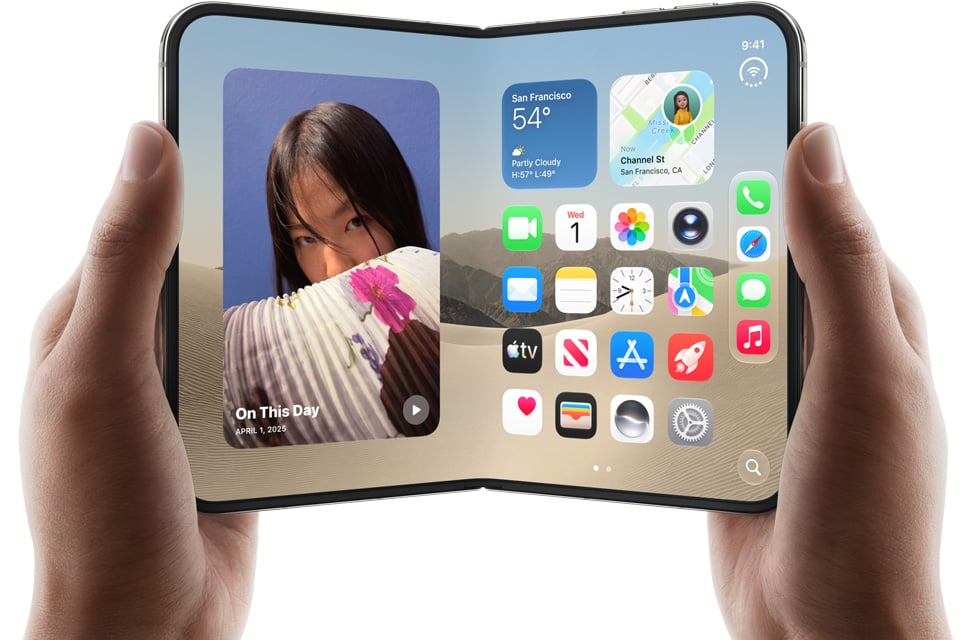
Apple’s first foldable iPhone, the iPhone Duo, is already sparking a very specific kind of nerd debate: has Cupertino finally beaten the dreaded foldable crease, or just hidden it well enough for now? Early coverage, including Engadget’s hands-on, agrees that the inner display looks impressively flat out of the box, but raises a key caveat — only time and thousands of folds will reveal how visible that crease really becomes.
Apple’s own language carefully threads the needle. On its official Duo product page and launch materials, the company describes the inner display as “wonderfully flat and smooth,” emphasizing a custom matte nano-texture finish designed to reduce glare and reflections while minimizing the visibility of the crease rather than erasing it entirely. The 7.6-inch Super Retina XDR inner screen is built from multiple ultrathin layers, including a stiff nano-texture polymer cover, glass reinforcement above and below the panel, and optically clear adhesives that allow the layers to slide a bit as the phone folds, reducing stress at the hinge line and helping keep the fold radius as gentle as possible. Apple also touts a Grade 5 titanium frame and hinge cover, dust-tight and water-resistant construction, and high brightness levels up to 3,000 nits outdoors, all aimed at convincing buyers the Duo is both premium and durable.
Hands-on impressions from the first wave of tech outlets paint a more nuanced picture than Apple’s marketing copy, but they do largely agree that the Duo’s crease is a lot harder to see than on most current foldables. Reviewers at CNET reported that in brief demo time the crease was “genuinely hard to see” and almost non-existent unless the phone was held under a strong video light, even though a slight ridge could still be felt when swiping across the middle of the screen. TechRadar’s initial hands-on described the crease as effectively “gone” to the eye, crediting the matte nano-texture layer with dispersing reflections so well that the line where the screen folds disappears in most viewing angles, even if a tactile bump remains under the finger. MacRumors likewise noted that while the crease is still visible in certain lighting, Apple appears to have done a better job of hiding it than Samsung’s latest Galaxy Z Fold models, and commentary around creator Dave2D’s early demo clips echoed the idea that the Duo offers one of the closest experiences yet to a “creaseless” foldable, with only a subtle ridge appearing at extreme angles.
That’s only half the story, though. Other coverage warns enthusiasts not to declare the crease problem solved just yet. A follow-up analysis at TechRadar, drawing on close-up images and user posts, pointed out that the Duo’s inner screen still shows a visible dip when tilted into bright light, with a vertical trench line cutting through the center of the unfolded display despite the matte coating. Reporters at 9to5Google came away from their demo saying the crease looked roughly as prominent as on Samsung’s Galaxy Z Fold 8 family, suggesting Apple hasn’t dramatically changed the fundamental optics of a foldable OLED panel. A piece from Sammy Fans bluntly argued that the Duo’s visible fold line is “physics” — a mechanical consequence of bending a stack of materials that cannot be completely eliminated, only managed. The MacObserver’s breakdown of Apple’s nano-texture claims reinforced that skepticism, explaining that much of what users identify as a “crease” is actually a reflection artifact rather than a distortion of the image itself, so a matte finish can make the line harder to see without changing the underlying bend in the panel.
Under the hood, Apple is clearly throwing serious engineering at that bend line. The Duo’s inner display stack reportedly uses around ten ultrathin layers, blending flexible OLED, supporting glass, polymer coatings, and those optically clear adhesives to distribute stress along the fold instead of concentrating it at a sharp hinge point. The nano-texture surface provides a matte feel and cuts specular reflections, which are where creases tend to “pop” visually, while still allowing the screen to hit high HDR brightness for games and video. Apple’s launch press release and FAQ repeatedly stress that the design is meant to “minimize crease visibility” rather than promise a perfectly flat foldable surface, and an Apple hardware engineering executive has even invited customers to “hold us accountable” over how the Duo’s crease and hinge age, acknowledging in interviews that the nano-texture layer was chosen in part to make any changes around the fold less noticeable over years of use.
That last point is where Engadget’s cautionary angle comes in: even the best demo room lighting and launch-day hands-ons can only tell us how the Duo’s crease looks when it’s brand new. Prior generations of foldables from other brands have shown that a barely-there crease at launch can deepen or become more obvious as the panel is opened and closed tens of thousands of times, especially if microscopic debris, heat cycles, and everyday pressure on the hinge start to alter how the display stack flexes. Apple’s titanium chassis, dust- and water-resistance, and sliding adhesive system are all designed to fight that kind of wear, but the company is implicitly asking buyers to trust that its long-term reliability testing will translate into the real world. Until the first wave of Duo owners has lived with the phone for months — gaming, streaming, doomscrolling, and snapping photos on that big inner canvas — the true verdict on the crease’s visibility and how it evolves over time simply doesn’t exist yet.
For now, the iPhone Duo sits in a strange place in the foldable landscape: an engineering flex that makes the crease far less distracting than on many rivals, but still a physical reality and a flashpoint for scrutiny from power users. Early adopters who value Apple’s ecosystem and are comfortable with the inherent quirks of folding hardware may see the Duo as the first iPhone that finally makes the book-style foldable form factor feel mainstream-ready. More cautious fans — especially those burned by aging creases or hinge issues on other devices — are likely to watch from the sidelines until long-term tests, teardown analyses, and real-world wear stories reveal whether Apple’s nano-texture, adhesives, and hinge design meaningfully change the crease game or simply refine the familiar trade-offs. Either way, the crease has become a central character in the iPhone Duo story, and it will take a lot more than a few days of hands-on buzz to decide whether Apple truly bent the rules of physics or just found a smarter way to live with them.


