
Meadow wants you to leave your main smartphone on the nightstand and still make it to the concert, game night, or D&D session with your tickets, maps, and playlists intact. The square, minimalist handset strips out social media, web browsing, email, and algorithmic feeds, while keeping just enough functionality to navigate the city, call a ride, snap a photo, and take a call. As founder Shreyas Narlanka put it, “We’re not Luddites… it’s just we don’t want social media, browsing, and that kind of stuff,” framing Meadow as a deliberate escape from doomscroll culture rather than a full-on tech rejection.
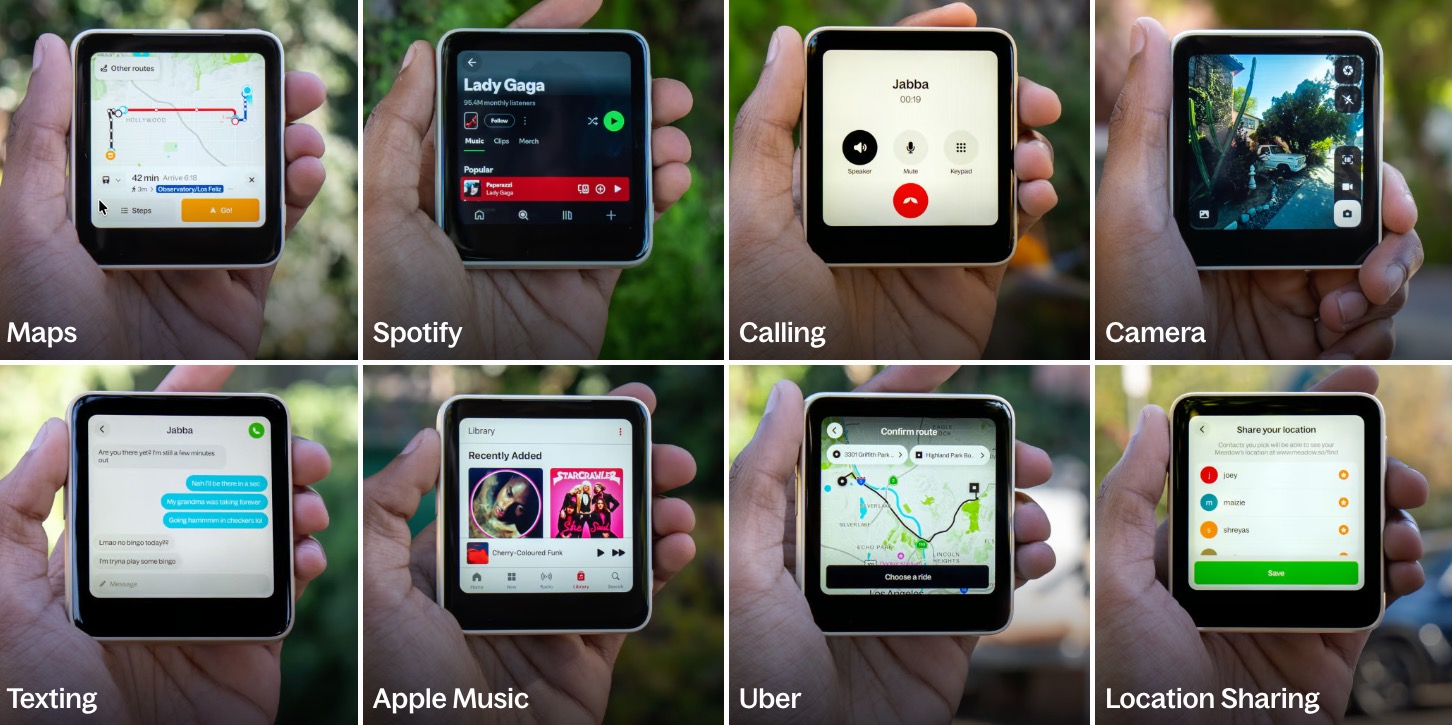
Physically, Meadow sits somewhere between a “dumb phone” and a compact Android slab: roughly half the size of a typical smartphone, weighing about four ounces, and built around a small touch display. It runs a stripped-down Android build with its own 4G connection via eSIM, so it functions as an independent device rather than a Bluetooth accessory. Instead of an app store, users get a curated roster of “out-and-about” essentials like maps and navigation, fitness tracking with services such as Strava, ride-hailing via Uber, and music streaming through Apple Music and Spotify. Core utilities — camera (around 13MP in some descriptions), voice memos, notes, basic texting and calling, ticket scanning, location sharing, and weather — are baked in, but anything that looks like infinite scroll or inbox zero is intentionally absent.
The attention design goes beyond app choices. Meadow gives you a second phone number and lets you whitelist around a dozen key contacts who can reach that private line, with everyone else effectively siloed until you’re back to your main phone. There are auto-reply and “driving” style notification modes meant to tell friends and family you’re currently in Meadow mode, cutting down on the social friction that usually comes with digital detox experiments. For geeks heading to conventions, LAN parties, or camping trips, that combination of maps, tickets, and a small contact list means you can still coordinate meetups and rides without getting sucked into group chats, feeds, or work email during what’s supposed to be downtime.
Narlanka, who is just 25, has been building toward this idea for a while. Before Meadow, he co-founded Scout, an inventory-management platform for online sellers, giving him startup experience even if this is his first full-blown hardware product. That track record helped him secure backing from investors, including a funding round led by Alana Goyal of Basecase Capital in December 2024 to push Meadow from concept device into real-world production. Multiple outlets report that the first bulk batch of Meadow phones has now gone out to early customers, marking the moment when the “intentional phone” stops being a design blog curiosity and starts facing the realities of everyday use.
For a gadget that promises less screen time, Meadow carries a very modern price tag. Early coverage put the device at around $399 for pre-orders, climbing to $449 at retail as production ramps up. A subscription is required for its bundled mobile service, landing somewhere in the $10–15 per month range or roughly $120 per year, with a free trial window of six to nine months depending on the plan and source. Launch availability is focused on the U.S. for now, with some reports pegging general shipping around June 2026 — though hands-on pieces and shipping notices suggest units are already in the wild. That means Meadow is competing not just with “dumb phones” and distraction-cutting apps, but with the very real cost of adding a second line and a second device to your life.
The philosophy behind that cost is pure intentional-tech rhetoric. Coverage from international outlets characterizes Meadow as a device aimed at helping people reclaim time in nature, deepen in-person social lives, and disconnect from the network without going off-grid entirely. Trend-watching sites describe it as a “pared-back” handset designed to protect attention and bring users back to the present moment, keeping only tools for calling, texting, maps, music, photos, notes, rides, and audiobooks. Gizmodo, meanwhile, dubbed it a “semi-dumb phone” that’s “barely even a phone,” pointing out that the lack of email, browser, and most apps will feel harsh for anyone who still needs productivity on the go. For Geek Slop readers, that tension is the point: Meadow is built for days when you want to focus on the movie marathon, the tabletop campaign, or the cosplay meetup, not your notifications — and if you’re willing to pay flagship money for fewer distractions, it might be the rare gadget that buys you back some attention instead of stealing more of it.


