
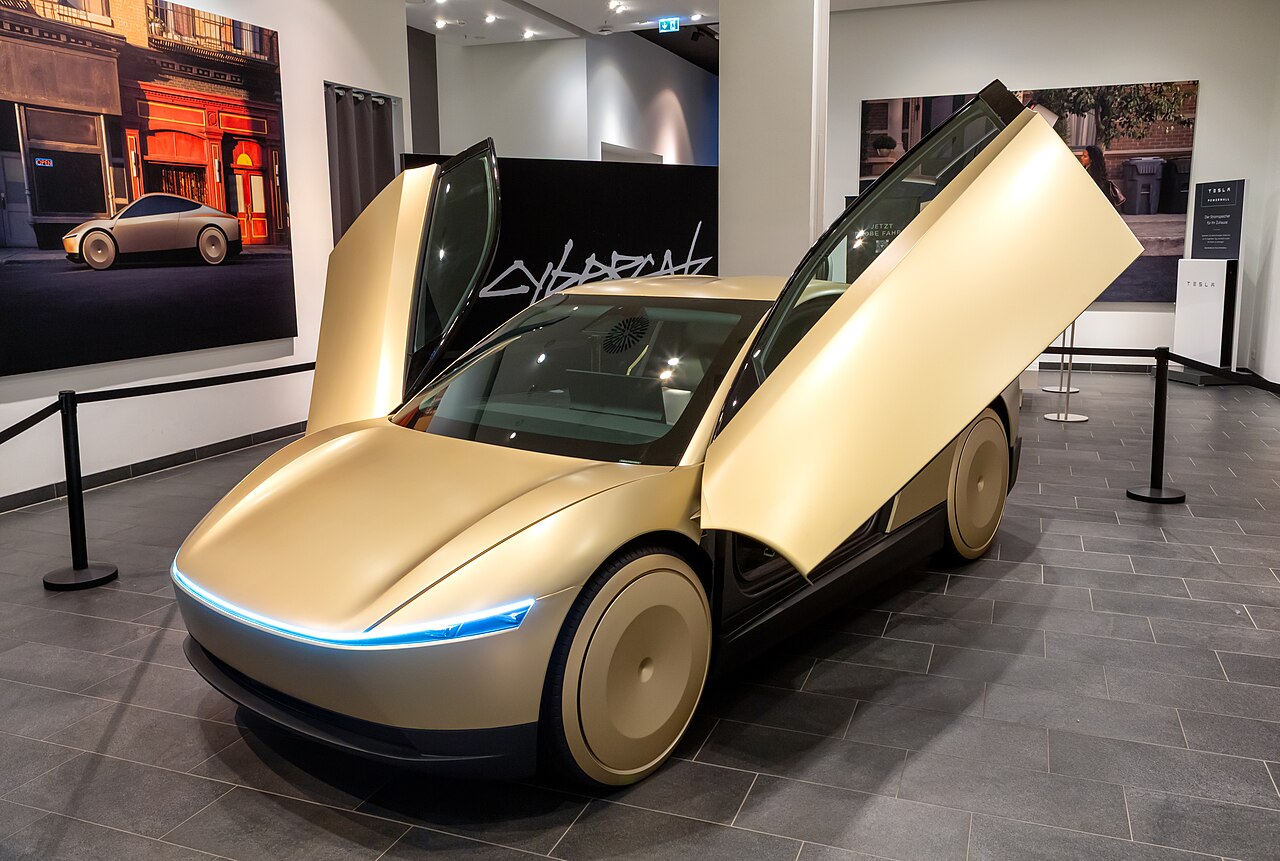
Tesla’s long-teased Cybercab is finally crossing the line from glossy render to real passengers, with the purpose-built robotaxi rolling into service as part of the company’s autonomous ride network in Austin, Texas. For Elon Musk, whose trillion-dollar compensation package and credibility are now deeply entangled with a camera-only approach to self-driving, Austin is shaping up as the proving ground for one of the boldest—and most controversial—bets in modern tech.
First unveiled nearly two years ago as a gold-tinted, gull-wing-door, two-seat pod with no steering wheel, the Cybercab was pitched as the pure expression of Tesla’s autonomy ambitions rather than just another retrofit of a consumer car. The production version now heading into service retains the steering-wheel-free, pedal-free layout and relies on Tesla’s latest AI4 compute platform to pilot itself, cementing its identity as a vehicle that ordinary drivers will never control. Before opening the doors to the public, Tesla has already been running engineering tests on Austin’s streets with production Cybercabs that include a safety monitor but no driver controls at all, a design the Texas Department of Transportation has formally acknowledged. According to multiple reports, the rollout is staged: employee rides on public roads first, then Cybercabs fold into Tesla’s existing Austin Robotaxi fleet—currently dominated by Model Y crossovers—later this month.
To wrap the launch in spectacle, Tesla has built a full event pipeline around the Cybercab’s debut. A sweepstakes running from August 17–23 offered entries to anyone taking Robotaxi rides during that window, with mail-in entries available for those outside Austin, and winners promised “exclusive access” to Cybercabs at a launch event. Invitations and local coverage point to a September 3 celebration at Tesla’s Austin hub, widely expected to be at or near the company’s Gigafactory Texas complex, with winners required to be at least 21 years old. Crucially, however, the event is a product unveiling, not a regulatory milestone—Tesla’s own messaging and outside reporting stress that the September 3 show does not itself constitute approval from federal safety regulators such as NHTSA.
What makes the Cybercab launch more than just another EV rollout is Musk’s insistence on a heterodox autonomy stack built around cameras alone. For years, he has derided lidar as “lame” and argued that a vehicle that can drive using only vision—much like a human—represents the only viable route to true self-driving. Tesla’s consumer vehicles already lean heavily into that philosophy, shipping with “Autopilot” and “Full Self-Driving” features that depend on multiple external cameras for navigation, steering, and braking. In contrast, many autonomous driving programs in the industry have layered lidar, radar, and detailed mapping on top of cameras to build redundancy into perception. Cybercab, by design, doubles down on Musk’s camera-only stance in a vehicle that isn’t even built with human controls as a fallback.
That philosophy is colliding with a messy track record. A previous robotaxi launch in Austin, highlighted in technology reporting in 2025, involved a small fleet operating in a limited geofenced area with safety drivers behind the wheel and strict constraints on weather and operating hours. Those guardrails underscored how far Tesla still had to go to reach the frictionless, nationwide robotaxi network Musk has repeatedly promised. The current Cybercab rollout again relies on safety monitors in the cabin during testing, even though those monitors have no conventional controls to grab if things go sideways, and internal timelines for expanding public access—initially targetted for late August—are being described as aspirational rather than locked. Add in the fact that the splashy September event is explicitly not a regulatory green light, and Cybercab’s first phase looks more like a high-stakes real-world beta than a full commercial launch.
Behind the scenes, Tesla is quietly building infrastructure to keep the experiment running. Permit documents and local business reporting show the company leasing a site at 405 St. Elmo Road in Austin as a dedicated charging hub designed to support a growing robotaxi fleet, including Cybercabs. As Tesla teases “exclusive access” at the September event and promises a livestream for everyone else, only a narrow slice of users—sweepstakes winners and existing Austin Robotaxi riders—will experience the steering-wheel-free cabs firsthand in the near term. How quickly Cybercab expands beyond that bubble will hinge on a mix of technical performance, regulatory tolerance for camera-only autonomy, and whether ordinary riders are willing to entrust their commute to a vehicle that looks more like a sci-fi shuttle than any car they’ve ever driven themselves. For now, the world’s geekiest transportation experiment is finally leaving the concept art stage and hitting real streets, and the stakes for Musk’s vision could not be higher.
Image Credits
In-Article Image Credits
Tesla Cybercab in der Mall of Berlin 2024 via Wikimedia Commons by Avda with usage type - Creative Commons LicenseFeatured Image Credit
Tesla Cybercab in der Mall of Berlin 2024 via Wikimedia Commons by Avda with usage type - Creative Commons License


