
Physicists have identified a new superconducting material that seems to bend one of nature’s most elegant mathematical rules, marking the first time a type I superconductor has been caught breaking time-reversal symmetry. The compound, ytterbium diantimonide (YbSb₂), behaves like a textbook conventional superconductor in many ways, yet develops tiny internal magnetic fields as it enters its superconducting state—clear evidence that the system no longer looks the same when time is mathematically run backward.
Superconductors are quantum materials that carry electric current with zero resistance and expel magnetic fields once cooled to extremely low temperatures, a phenomenon known as the Meissner effect. Classic, or type I, superconductors fully repel magnetic fields until a critical value is reached, while type II superconductors let fields thread through in quantized vortices, often accompanying more exotic quantum behavior. Time-reversal symmetry is the idea that the underlying equations of motion should work identically whether time flows forward or backward; when a superconductor breaks that symmetry, its quantum state knows the difference between “past” and “future,” typically via spontaneous internal magnetism. Until now, such time-reversal symmetry breaking had only been firmly associated with unconventional or type II systems, making YbSb₂ an outlier that forces a rethink of where the line between “conventional” and “weird” really lies.
The new result comes from an international team led by researchers at the Indian Institute of Science Education and Research (IISER) Bhopal, working with collaborators at the Indian Institute of Technology Kanpur, the University of Warwick, and the ISIS Neutron and Muon Source in the UK. The group grew high-quality single crystals of YbSb₂ and verified their structure and purity with X-ray techniques before probing how the material responded to cooling and magnetic fields. Measurements of electrical resistance showed it abruptly became superconducting at temperatures around -272 degrees Celsius, just above absolute zero, while heat capacity data and magnetization tests confirmed YbSb₂ is a fully gapped, type I superconductor with a robust energy barrier that tightly binds its electron pairs.
The real plot twist emerged when the team looked for signs of magnetism in the superconducting state using muon spin relaxation and rotation (µSR), a technique in which implanted muons act like ultra-sensitive local magnetic probes. In zero external magnetic field, the researchers observed the onset of extremely small internal magnetic fields—on the order of 0.44 gauss—right as the material crossed into its superconducting phase. Because magnetic fields reverse direction when time is mathematically flipped, their spontaneous appearance in a field-free environment is a smoking gun for time-reversal symmetry breaking. The group’s Physical Review Letters paper and earlier preprint on the subject argue that this makes YbSb₂ the first known type I superconductor whose superconducting state intrinsically violates time-reversal symmetry.
For quantum tech watchers, that combination—conventional-looking, fully gapped superconductivity plus broken time-reversal symmetry—is especially tantalizing. Type I superconductors are generally simpler to describe than their unconventional cousins, and a robust energy gap can protect the delicate paired-electron state from disturbances, traits that theorists often look for when dreaming up stable qubit platforms. Commentaries on the work suggest that YbSb₂’s unusual quantum order could inform future designs for quantum computers that exploit symmetry-breaking to encode information in more resilient ways, even if this material itself operates only at temperatures near absolute zero. At the very least, it expands the catalog of superconducting behaviors that engineers might one day try to harness, hinting at new paths toward devices where “forward” and “backward” in time aren’t equivalent in the underlying quantum logic.
On the theoretical side, the finding lines up with recent ideas that loop supercurrents or multi-component order parameters can spontaneously break time-reversal symmetry in otherwise conventional superconductors. YbSb₂ now offers a concrete playground to test those frameworks and to explore whether similar behavior lurks in other compounds with related crystal structures. The team’s result has already been amplified by IISER Bhopal’s own announcements and science news outlets worldwide, underscoring how a small internal magnetic field in a chilled crystal can send shockwaves through condensed matter physics. Follow-up experiments—using µSR, advanced spectroscopies, and new probes of quantum order—will be crucial to pin down exactly how this superconductor bends the rules of time and to see whether its strange symmetry-breaking can be tuned, controlled, or replicated in more practical platforms.
Image Credits
In-Article Image Credits
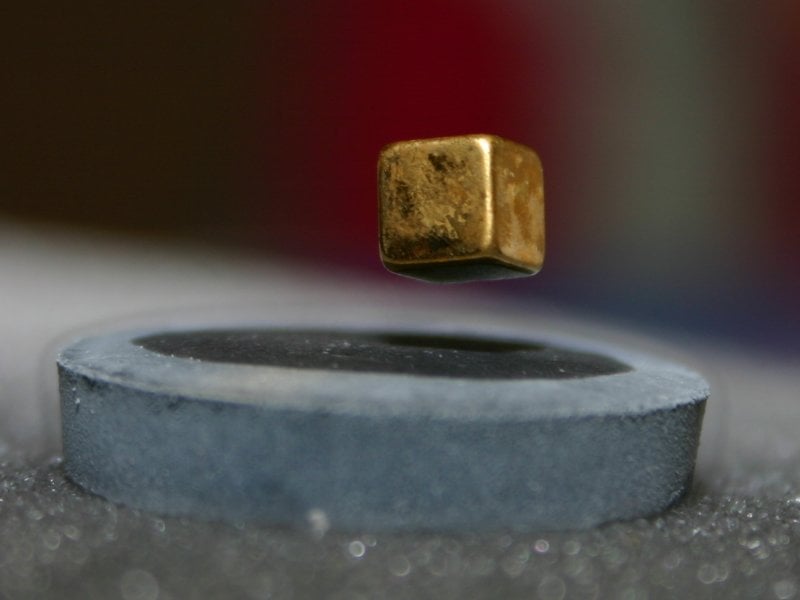
A magnet is suspended over a liquid nitrogen cooled high-temperature superconductor via Wikimedia Commons by Peter nussbaumer with usage type - GNU FreeFeatured Image Credit
A magnet is suspended over a liquid nitrogen cooled high-temperature superconductor via Wikimedia Commons by Peter nussbaumer with usage type - GNU Free


