
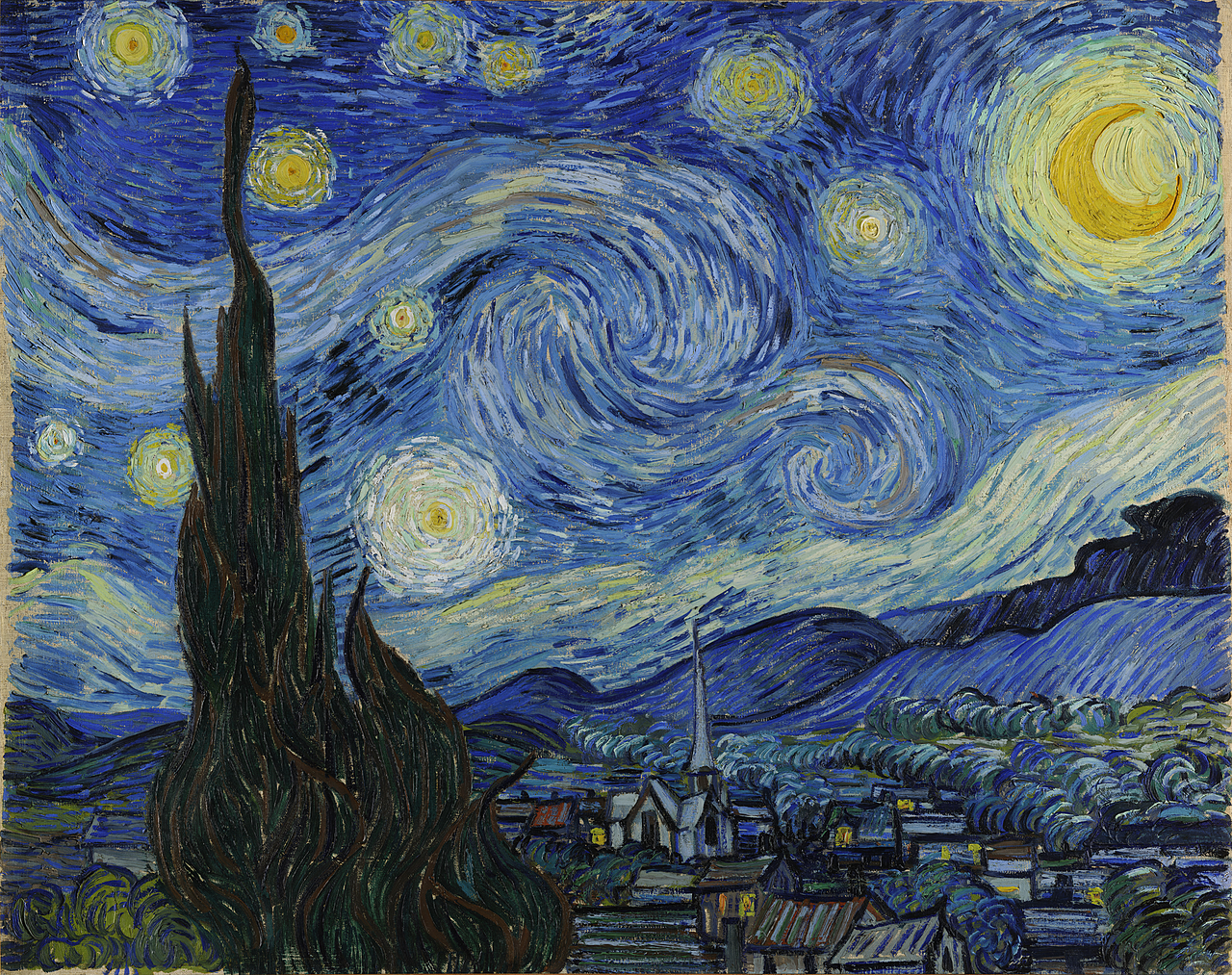
Vincent van Gogh’s The Starry Night may be less a dreamlike invention than a radically transformed snapshot of the sky. A new multidisciplinary study places the painting’s celestial arrangement around dawn on July 22, 1889, when a waning crescent Moon, Venus and the Hyades star cluster appeared together above Saint-Rémy-de-Provence. The proposed identification of the sky gives fresh weight to the idea that Van Gogh observed real astronomical details before reshaping them through his unmistakable style.
Published October 22 in Scientific Reports, the study was led by Elijah Jeong-hyun Kim alongside Suna Kang, Jungwoo Song and Ho Jin, researchers affiliated with South Korea’s SLLAB and Kyung Hee University. Their paper, “The actual sky of Van Gogh’s Starry Night: a multidisciplinary reconstruction,” combines astronomical simulations, field surveys, historical weather records, Van Gogh’s letters and measurements of the stars painted on the canvas.
The team began with the landscape rather than the stars. A related Van Gogh drawing, catalogued as F1541v, helped researchers estimate the narrow field of view represented in the composition and compare it with terrain around the Saint-Paul-de-Mausole asylum, where Van Gogh was staying. They then tested possible celestial arrangements using software including TheSkyX and Stellarium, while checking historical planetary positions against NASA’s JPL DE441 data.
The strongest match centered on the Hyades, a V-shaped group in Taurus. The researchers found that the relative geometry of the painted stars corresponds unusually well with that cluster, while Venus and the Moon occupy positions compatible with the same pre-dawn window. The study’s shape analysis selected the Hyades as the best five-star correspondence among tested alternatives, including Aries, Lyra and Auriga. Coverage from Science News likewise describes the result as evidence that the canvas may preserve an actual observed arrangement rather than a wholly invented sky.
That conclusion complicates the long-standing June 1889 dating associated with the painting. Van Gogh mentioned a “new study of a starry sky” in an June 18 letter, but the researchers argue that the letter establishes the work had begun—not necessarily that it was finished then. They also examined later correspondence describing heat, cicadas, strong winds and the duration of Van Gogh’s illness, finding several clues more compatible with conditions in July. Those clues remain indirect: the study does not claim that Van Gogh calculated the heavens in advance or produced an untouched, literal transcription of one night.
Instead, the proposed interpretation is more interesting for art fans: observation and imagination were working together. Van Gogh may have seen the Moon, Venus and Hyades in a real sky, then enlarged, curved and rearranged them to fit the emotional force of the composition. As Smithsonian magazine’s coverage notes, the finding does not settle every question about when the painting was begun or revised. It does, however, shift the central mystery: The Starry Night may not be fantasy versus reality, but reality amplified into one of modern art’s most unforgettable visions.
Image Credits
In-Article Image Credits
Vincent van Gogh The Starry Night painting via Wikimedia Commons with usage type - Public Domain. 1889Featured Image Credit
Vincent van Gogh The Starry Night painting via Wikimedia Commons with usage type - Public Domain. 1889


