
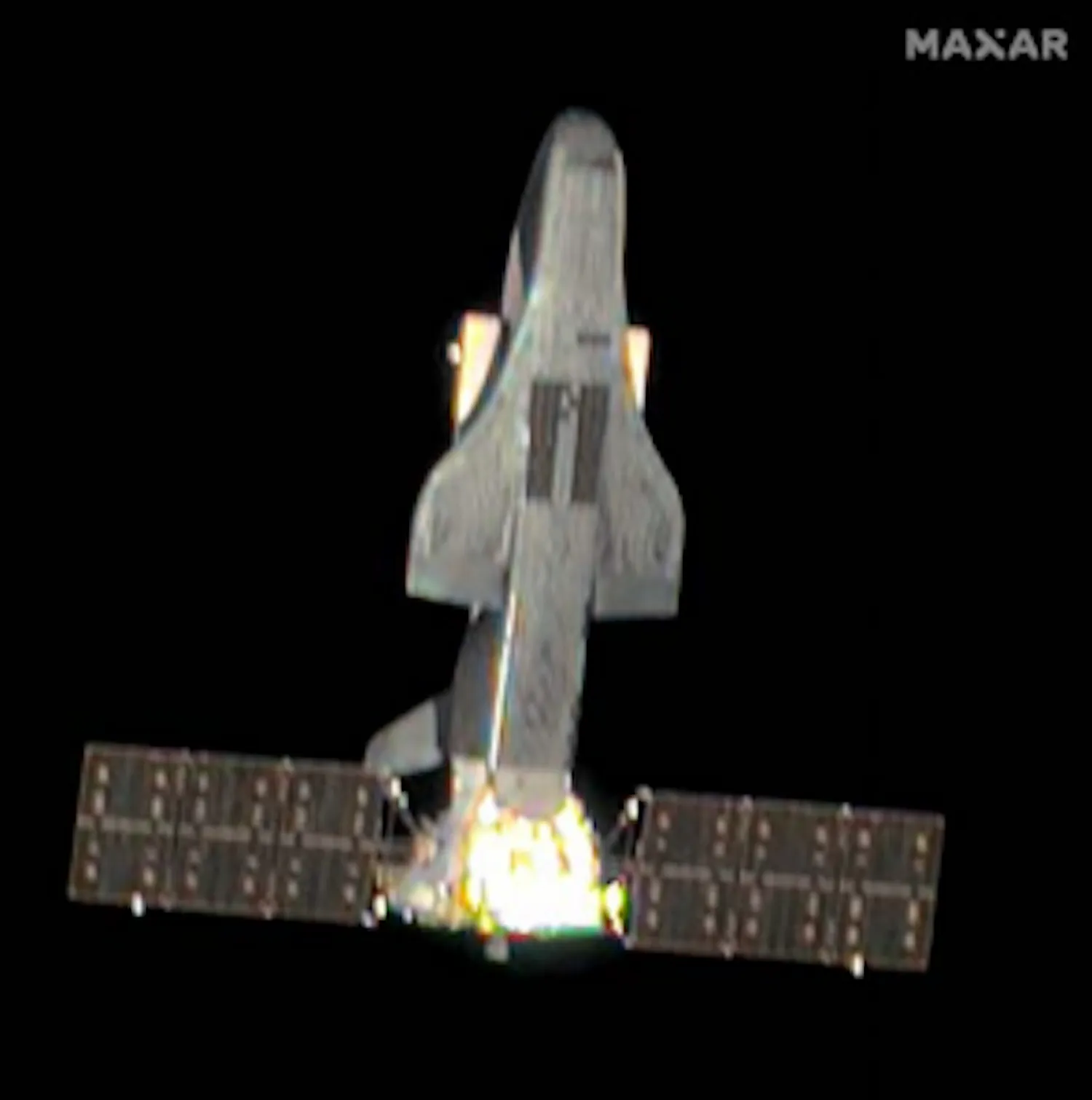
China’s elusive reusable spaceplane is no longer quite so elusive. A newly released image from a U.S. intelligence assessment shows the uncrewed vehicle in orbit with unusual clarity, exposing a compact winged design that closely echoes the silhouette of the U.S. Space Force’s X-37B. The new orbital photograph of China’s spaceplane was captured by a commercial satellite in 2024 and later included in a publicly available Defense Intelligence Agency assessment.
The image shows more than a vague shuttle-like outline. The spacecraft has delta-shaped wings, a dark heat-shielded underside, open payload-bay doors, twin vertical stabilizers, and a rear-mounted service module equipped with solar arrays. A separate object appears to be attached at the back, although its purpose remains unclear. Analysts have not publicly established whether the image shows China’s Shenlong vehicle or another program associated with the country’s broader reusable-spaceplane research. Independent analysis of the image likewise identifies the craft as strongly similar to the X-37B while cautioning that its precise mission remains unknown.
The photograph was taken on May 28, 2024, by WorldView-3, a high-resolution imaging satellite operated at the time by Maxar Technologies. The company’s intelligence business now operates as Vantor, whose constellation includes WorldView-3 and other commercial Earth-observation spacecraft. NASA describes Vantor as a provider of high-resolution imagery and spatial-intelligence products, illustrating how satellites built primarily to watch Earth can also be redirected toward objects passing overhead. The spacecraft was photographed from less than 90 kilometers away, an extraordinary viewing opportunity made possible by carefully timed orbital geometry.
China has launched the experimental vehicle on four known orbital missions since 2020, each using a Long March 2F rocket. The first lasted only two days, while the second remained aloft for 276 days. The third mission launched on December 14, 2023, and returned on September 6, 2024, after 268 days in orbit. During that flight, the spacecraft was observed releasing smaller objects whose functions have not been publicly explained. A fourth mission launched on February 7, 2026, and was still in orbit as of late October, according to available coverage.
The resemblance to the X-37B is significant, but appearance alone does not establish that the two vehicles perform identical work. Reusable spaceplanes can carry payloads, test hardware, deploy satellites, conduct experiments, and return sensitive equipment to Earth. China’s spacecraft appears to operate in low Earth orbit, while the X-37B has completed missions lasting years and has flown at substantially higher altitudes on at least one flight. That overlap in capability—and the secrecy surrounding both programs—has made the Chinese vehicle a recurring focus of military and aerospace analysts.
For commercial imaging companies, the episode is also a reminder that “secret” spacecraft are increasingly difficult to keep out of public view. A satellite designed to map terrain can sometimes capture another spacecraft at close range, while independent trackers can reconstruct launch schedules and orbital paths from publicly available data. The image does not reveal the Chinese vehicle’s payload or objectives, but it does provide the clearest public evidence yet of its configuration—and confirms that reusable orbital vehicles are becoming a major part of the strategic competition above Earth.
Image Credits
In-Article Image Credits
China’s elusive top secret reusable spaceplane via Department of DefenseFeatured Image Credit
China’s elusive top secret reusable spaceplane via Department of Defense


